Emergency AC Repair Hero — Delano HVAC

Emergency AC Repair
in Delano, CA

Air conditioner out? We take emergency calls 24 hours a day, 7 days a week.

Delano HVAC provides emergency AC repair in Delano, CA for homes where the air conditioner has stopped cooling and can't wait. Tell us what the system is doing. We'll send a technician who finds the fault, gives you a written quote, and makes the repair once you approve it.

  • Homes only
  • 24/7 emergency line
  • Delano 93215 & 93216
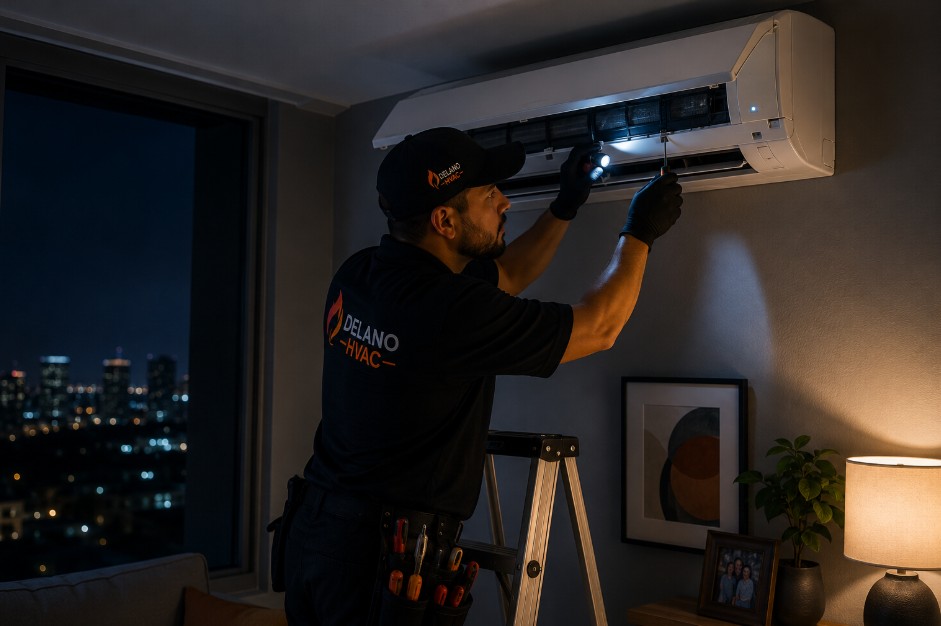
Technician repairing an AC unit at night in Delano

What Emergency AC Repair Means in a Delano Summer

An AC emergency here is easy to describe: the house is getting hotter, and the air conditioner isn't stopping it. Delano's July afternoons average about 97°F, and a typical summer peaks near 106°F. In a stucco, slab-on-grade house with its ductwork in the attic, the indoor temperature starts climbing soon after the system quits, and it keeps climbing into the evening.

That's why we run emergency AC repair as a 24-hour service, not an add-on to the daytime schedule. A call covers central split systems, package units, and the air handler, ducts and thermostat wiring that serve them, in owner-occupied houses, rentals and manufactured homes. This service is for homes only.

  • About97°F Average July afternoon in Delano
  • About106°F Typical summer peak
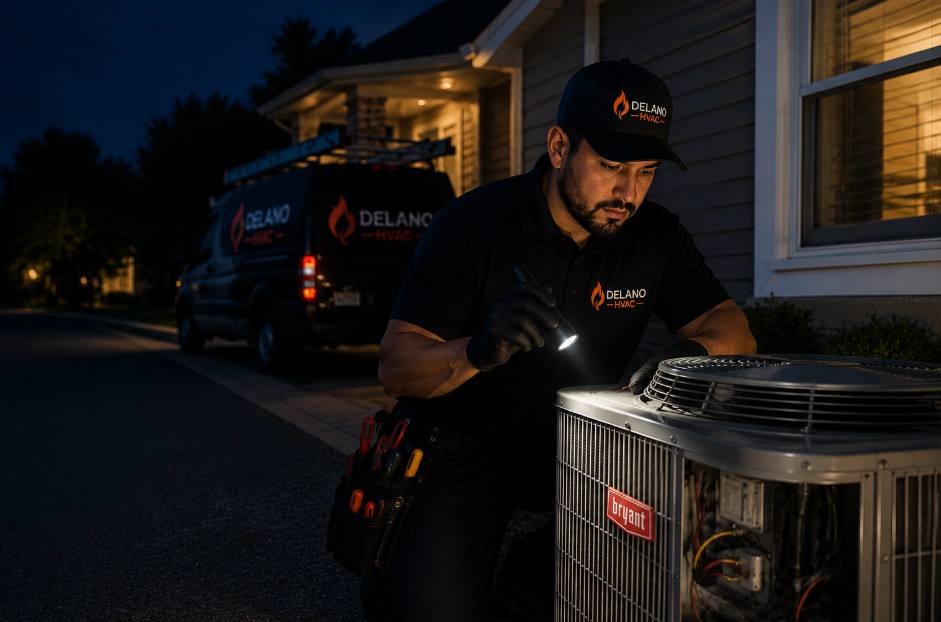
AC technician checking emergency cooling issue in Delano

Call Now or Book a Regular Repair?

Call us now

  • No cooling at all, with a forecast in the high 90s or above
  • No cooling, and someone at home is over 65, a baby or young child, pregnant, or has a condition made worse by heat
  • Burning or electrical smell, smoke at the outdoor unit, or a breaker that trips again after one reset
  • Ice on the copper lines or the indoor coil, with airflow dropping
  • Water coming through a ceiling or pooling around the indoor unit
  • The outdoor unit hums, but its fan won't spin

Usually fine to book a regular repair

  • The AC cools, but runs longer than it used to on hot afternoons
  • Your Southern California Edison bill jumped, but the house stays comfortable
  • One or two rooms run warmer than the rest
  • A new rattle or hum, but cooling is normal
  • The thermostat is slow to respond but still turns the system on

If everything you're seeing is in the right-hand column, a standard AC repair visit during regular hours is the better fit.

Call 911 before calling us if anyone shows signs of heat stroke (confusion, fainting, or hot, red skin with a very high body temperature), or if you see smoke or flames or smell gas.

Emergency AC Repairs We Handle in Delano Homes

These are the problems homeowners usually describe when they call, and what our emergency air conditioning repair visits most often find behind them.
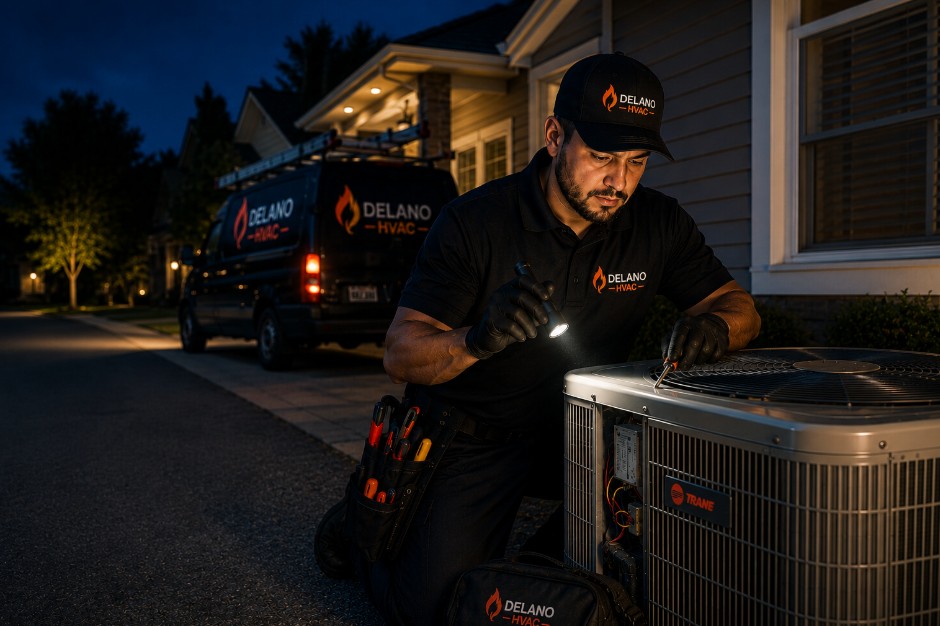
Technician repairing a central AC unit on an emergency call in Delano
  • What you see

    Outdoor unit hums, but the fan won't turn or the system won't start.

    What we usually find

    Usually a failed capacitor, a pitted contactor or a seized condenser fan motor. These parts run hot all summer here and often give out right after an Edison outage or voltage dip.

  • What you see

    The system runs, but the vents blow warm air.

    What we usually find

    Often a refrigerant leak, or a compressor that has shut itself off on its thermal overload. It can also be an outdoor coil so matted with cotton lint and field dust that the system can't release heat and trips on high pressure.

  • What you see

    Ice on the lines and weak airflow.

    What we usually find

    A frozen indoor coil. The cause is usually a filter clogged faster than expected in harvest dust, a failing blower motor, or low refrigerant.

  • Priority call
    What you see

    The breaker trips, or there's a burning smell.

    What we usually find

    A shorting compressor or fan motor, scorched wiring at the outdoor disconnect, or a failing contactor. Leave the breaker off until we've checked it.

  • Priority call
    What you see

    The AC has shut off, and there's water near the indoor unit.

    What we usually find

    A blocked condensate drain, where the float switch has cut power to stop an overflow. With an attic air handler, the first sign is often a stain on the ceiling.

  • What you see

    The thermostat is blank or not responding.

    What we usually find

    We check power and the low-voltage wiring at the air handler. If the thermostat itself has failed, see our page on blank or unresponsive thermostats.

Ductless systems and heat pumps fail differently and have their own pages: urgent ductless repairs and heat pump breakdowns.

How an Emergency Call Works, Start to Finish

Every emergency call goes through the same seven steps. How long each one takes depends on how many homes are without cooling that day, so we keep you told where things stand.

  • On the phone 1 First call · 2 Triage · 3 Dispatch
  • At your home 4 Arrival · 5 Diagnosis · 6 Quote and approval · 7 Repair and cleanup
On the phone
  1. The first call

    Call us or reach out online, any hour. We'll ask:

    • what the AC is doing (no power, warm air, ice, water, a smell, a tripped breaker) and when it started
    • the type of system, and its brand and rough age if you know them
    • your address and nearest cross street. For rural roads outside town, a landmark or map pin helps.
    • access details: gate codes, a locked side yard, dogs, and where the indoor unit is (hall closet, garage or attic)
    • who's at home, especially older adults, babies or anyone with a medical condition, and how warm it is inside

    The call is for getting the right technician to the right door. We don't diagnose over the phone.

  2. Triage

    Calls with a safety risk (burning smell, repeat breaker trips, water through a ceiling) go first, along with homes where heat-sensitive people have no cooling. On the call, we tell you whether to shut the system off and how to keep the house cooler until the technician arrives.

  3. Dispatch

    A technician is assigned, and we give you an estimated arrival based on current calls and your location. During a heat wave that estimate can change. If it does, we tell you rather than leave you guessing.

At your home
  1. Arrival

    The technician checks in at the door, confirms what you've seen, and asks to see the thermostat, the indoor unit and the outdoor unit. In many Delano homes that means the attic hatch, so clearing a path to it saves time.

  2. Diagnosis

    Testing comes before parts. That means electrical readings on the capacitor, contactor, fan motor and disconnect, refrigerant pressures and temperatures, airflow across the indoor coil, the drain line and float switch, and the condition of the outdoor coil. You're told what failed and why.

  3. Written quote and your approval

    The quote lists the repair, the parts and the labor, and says whether the part is on the truck or has to be ordered.

    No repair work starts until you approve it.

    If you rent, we can wait while you reach the owner or property manager.

  4. Repair, testing and cleanup

    After the repair, the system runs under full load while the technician checks the temperature drop across the coil, the refrigerant pressures and the motor amperage. Old parts and packaging leave with us, any attic insulation we moved goes back in place, and you get a walk-through of what was done.

Why Delano Heat, Dust and Housing Wear Out ACs

Three local conditions come up again and again on emergency calls.

  • Heat: run time

    The first is run time: from June through September a Delano AC can run most of the afternoon and evening, day after day.

    The capacitors and contactors that start the compressor wear fastest under that load.

  • Dust: what's in the air

    The second is what's in the air. Lint from cotton fields, dust from vineyard rows and farm roads, and grit thrown up along Highway 99 settle into the outdoor coil's fins, so the system pushes against higher pressure every hot day.

  • Housing: less margin

    The third is the housing. Older stucco homes with attic ducts, swamp cooler conversions with too few returns, and manufactured homes with tight equipment closets all leave less margin when the weather peaks.

Add the voltage dips and outages that heat waves can bring on Southern California Edison's lines, and you get most of the failures listed above.

What Gets Fixed on the First Visit, and What May Take a Second

Usually fixed on the first visit

  • Capacitors and contactors
  • Fuses and disconnect wiring
  • Condenser fan motors in common sizes
  • A clogged drain and tripped float switch
  • A matted outdoor coil
  • A frozen coil once the airflow cause is found

May need parts and a follow-up visit

  • A compressor
  • An indoor or outdoor coil
  • Brand-specific control boards and variable-speed blower motors
  • A refrigerant leak inside a coil

Refrigerant and parts

Systems built before 2025 mostly use R-410A, and as manufacturers move new equipment to lower-impact refrigerants, some R-410A parts take longer to source. Units built for R-22 can only be recharged with reclaimed refrigerant.

If a part has to be ordered

When a part has to be ordered, the technician tells you what's on order and whether a temporary step can restore some cooling in the meantime. We won't promise a delivery date we don't control.

If the AC isn't worth repairing, the technician explains your options and the choice is yours. Our page on replacing an air conditioner covers that route.

Safety Steps Until the Technician Gets There

Gas smell, smoke or flames, or anyone with signs of heat stroke: call 911 first.

If you see a problem

While you wait

Is it the power or the AC?

Power out

If the lights and outlets are out too, the problem is the power supply. Check Southern California Edison's outage information or report the outage to SCE.

Power back on

When power returns, give the thermostat a few minutes before cooling starts. If the outdoor unit then hums without its fan turning, switch it off and call us. Restarts after an outage are a common moment for a capacitor to fail.

What Affects the Repair Cost

The price depends on what failed, not on the symptom you called about. You get a written quote before any repair starts.

What moves the number
  • The failed part.

    Swapping an electrical part is a smaller job than replacing a coil or a compressor.

  • Parts on hand or ordered.

    A part on the truck finishes today. An ordered part adds a second visit.

  • Refrigerant.

    The type (R-410A, older R-22, or a newer lower-impact refrigerant) and how much is needed once a leak is repaired.

  • Access.

    An attic air handler on a July afternoon, a roof-mounted package unit, or a locked or gated yard all add time.

  • Age and condition.

    Older units often have more than one worn part.

  • Permit work.

    A repair that turns into replacing refrigerant-carrying equipment can bring in permit and testing costs (see Permits below).
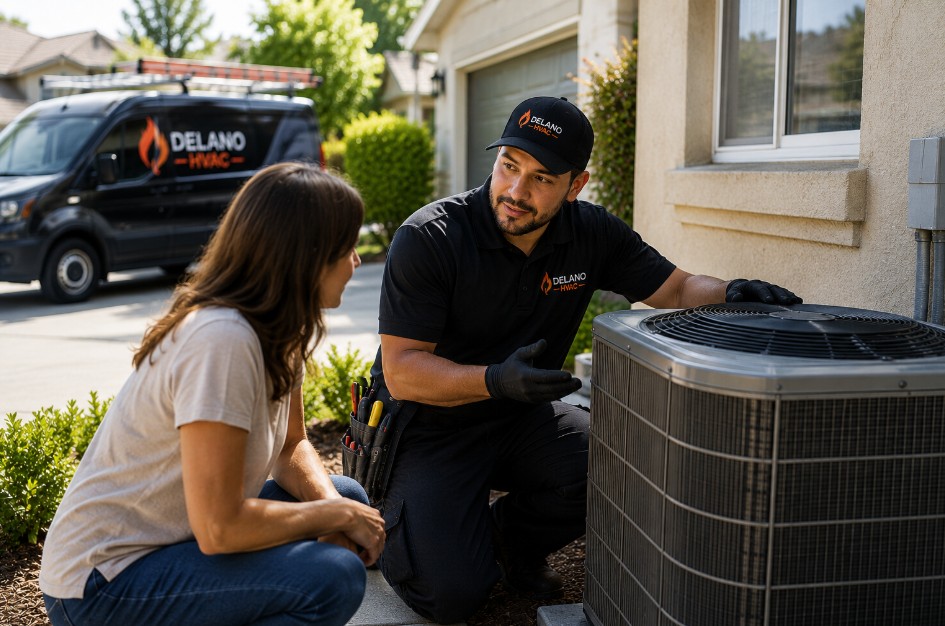
AC technician explaining a cooling problem to a homeowner

Older Cooling Setups, Rentals and Manufactured Homes

  • Swamp cooler conversions

    Downtown & east of Highway 99

    Many older homes downtown and east of Highway 99 started out with evaporative coolers. When refrigerated AC was added, the old duct layout was often reused, with too few or too small return vents. Those systems run near their limit on the hottest days, which shows up as frozen coils and overworked blower motors. On an emergency call we restore cooling first and note any duct problem for you to decide on later.

  • Manufactured and mobile homes

    Package units & under-floor ducts

    The equipment is often a package unit beside the home or a split system feeding ducts under the floor, with tight access, so parts and clearances differ from a site-built house. If a repair turns into replacing equipment in a home inside a mobilehome park, the permit may go through the California Department of Housing and Community Development rather than the city.

  • Rentals

    Tenants can call us directly

    Close to half of Delano's occupied homes are rented (2020 Census). Tenants can call us directly. Before repair work starts, we need approval from whoever is paying for it, and the written quote can go to the owner or property manager.

Systems and Brands We Repair

On emergency calls we repair

  • Central split air conditioners
  • Package units
  • Air handlers
  • Blowers
  • Coils
  • Thermostat wiring

Brands we service include

  • Carrier
  • Goodman
  • Lennox
  • Trane
  • Bryant
  • Daikin
  • Rheem
  • York
  • American Standard

Across Delano's mix of older bungalows, newer tract homes on the edges of town and manufactured home communities, that covers most of what's installed, from older R-22 units to systems built for newer refrigerants.

Permits and Rules That May Apply

Most emergency repairs need no permit

  • Swapping a capacitor, contactor, fan motor or blower wheel
  • Clearing a drain
  • Sealing a leak at a fitting

When a repair counts as an alteration

Replacing a part that holds refrigerant, such as the outdoor condensing unit, an indoor coil or, in some cases, the compressor, can count as an alteration under California's Energy Code (Title 24, Part 6).

That brings in a mechanical permit from the City of Delano inside city limits, or Kern County outside them, plus field verification under the state's Energy Code Compliance (ECC) program, which took over from HERS testing in 2026.

If your repair falls into that category, you'll know before you approve the quote.

  • Only EPA Section 608-certified technicians handle refrigerant.

  • In California, HVAC work over $1,000, or any job that needs a permit, must be done by a licensed contractor.

  • Delano HVAC holds a C-20 heating and air conditioning license.

Questions Delano Homeowners Ask When the AC Quits

11 questions

Is there 24 hour AC repair in Delano, CA?

Yes. Delano HVAC takes emergency AC calls 24 hours a day, 7 days a week, for homes in Delano and nearby McFarland, Wasco and Richgrove. Regular, non-urgent appointments are scheduled Monday through Sunday, 9 AM to 8 PM.

My AC died at night. Can it wait until morning?

Sometimes. If the house is cooling off, nobody at home is especially sensitive to heat, and there's no burning smell, tripped breaker or leak, a morning visit is often fine. If it's still hot inside, someone at home is elderly, very young or medically vulnerable, or there's any sign of an electrical problem, call us now. In late summer, attic heat can keep a stucco home warm well after sunset.

Can I keep running my AC if it's only blowing warm air?

It's better to turn cooling off. Warm air usually means the compressor isn't doing its job, whether from a refrigerant leak, an overheated compressor or a blocked outdoor coil, and running it that way can turn a smaller repair into a larger one. Leave the fan on if it helps move air, and call us.

Why does my AC keep tripping the breaker when it's hot out?

On a Delano afternoon the compressor is pulling its hardest, so a weak capacitor, a shorting motor, a failing contactor or a dust-clogged outdoor coil often shows up first as a tripped breaker. Reset it once. If it trips again, leave it off, because repeated resets can damage the compressor and the wiring.

My power came back on after an outage and the AC won't start. Is it broken?

Not necessarily. Many thermostats wait a few minutes before restarting the compressor, and the outdoor disconnect or the breaker may have tripped. If the outdoor unit hums but the fan won't spin once power is steady, switch the AC off and call us, because a failed capacitor after a power event is one of the most common things we find. If the whole house is still dark, check Southern California Edison's outage information first.

Why is water dripping from my ceiling near the AC vent?

In homes with the air handler in the attic, a blocked condensate drain or an overflowing drain pan usually shows up first as a ceiling stain or drip. Turn the system off, catch the water, and call us. We clear the drain, check the float switch and pan, and make sure the coil isn't frozen.

Will I know the price before the technician starts the repair?

Yes. After diagnosis you get a written quote listing the repair, the parts and the labor, and nothing is repaired until you approve it. Pricing depends on what failed and on your system, so confirm it with our professionals rather than relying on a phone estimate.

I rent my home. Can I call for emergency AC repair myself?

Yes. You can call us and we'll dispatch a technician. Before the repair starts we need approval from whoever is paying for it, whether that's you, the owner or the property manager, and we can send the written quote to them.

Do you repair air conditioners in mobile and manufactured homes?

Yes. We work on the package units and split systems used in manufactured homes, including in communities such as Cypress Gardens. Access and parts can differ from a site-built home, so tell us the home type when you call.

Can you get an older R-22 air conditioner running again?

Often, yes, if the fault is electrical, such as a capacitor, contactor or fan motor. If the system has lost refrigerant, things are harder: R-22 is no longer produced, so a recharge depends on reclaimed supply and on whether the leak can be repaired. The technician explains what's realistic for your unit before you approve anything.

Where can I stay cool while my AC is being repaired?

Stay in the coolest room with the blinds closed and fans running, and keep drinking water. When the National Weather Service forecasts 105°F or higher for the valley floor, Kern County opens cooling centers, and the City of Delano has run its own at the Jefferson Community Center. Check current locations and hours before you go.

Need Emergency AC Repair in Delano, CA?

Tell us what your air conditioner is doing, where you are, and who's at home. We'll triage the call and send a technician to your door anywhere in 93215 or 93216, day or night.

  • Emergency calls 24/7
  • Written quote before any repair
Scroll to Top
+1 661 580-0073