
HVAC System Replacement in Delano, CA
Energy-Efficient AC Systems for Delano Homes, Built to Handle Every Central Valley Summer
At Delano HVAC, our HVAC system replacement service in Delano helps homeowners move from aging, inefficient equipment to properly specified modern systems that deliver better comfort with lower energy consumption. If your current system is approaching the end of its service life or no longer performing as it should, a replacement is often the most cost-effective long-term decision — and our AC installation service walks you through every option before you commit to anything.
- Energy-Efficient System Upgrades
- Residential HVAC Specialists
- Long-Term Performance Focus
- Serving Delano, CA — Residential Only
HVAC System Replacement in Delano, CA — Upgrade Your Home Comfort System
At Delano HVAC, our HVAC system replacement service in Delano is designed to help homeowners make one of the most consequential decisions in home ownership with full information and no pressure. Replacing an HVAC system is not a routine service call — it's a long-term investment in your home's comfort, energy performance, and property value, and it deserves to be approached the same way.
Most residential HVAC systems are designed for a service life of 15 to 20 years under normal operating conditions. In Delano, where air conditioners run continuously for four to five months of the year and furnaces face regular demand through winter, that life cycle often compresses. As systems age, their efficiency declines in ways that aren't always visible. Refrigerant circuits develop minor leaks that go undetected for seasons. Heat exchangers accumulate stress from years of thermal cycling. Compressors run at reduced capacity while consuming the same or greater energy. A system operating at 70 percent of its original efficiency isn't just uncomfortable — it's quietly adding to your energy bills every month while delivering less than it should.
A useful benchmark: If your HVAC system is more than 12–15 years old and has required significant repairs in the past two seasons, the cost of continued repairs often approaches or exceeds the value those repairs return — making replacement the more financially sound decision.
There's a meaningful difference between repairing a system that has years of reliable service remaining and continuing to invest in one that has genuinely reached the end of its practical life. Modern HVAC systems operate at significantly higher efficiency ratings than equipment manufactured ten or fifteen years ago — higher SEER ratings for cooling, better AFUE ratings for heating, and improved control options that allow more precise temperature management throughout your Delano home. For homeowners ready to make that transition, our AC installation service in Delano and furnace installation service handle the full specification, sizing, and installation process with the same licensed technicians and upfront pricing approach you'd expect from any service we provide.
Replacement is also an opportunity to recalibrate your system for your home as it exists today — not as it was when the original equipment was installed. If your household has changed, rooms have been added, insulation has been upgraded, or windows have been replaced, those changes affect the load calculation that determines correct system size. A properly sized replacement system outperforms an oversized or undersized original in every category: efficiency, comfort, humidity control, and longevity. Pairing a new system with a scheduled HVAC maintenance plan in Delano from day one ensures that investment continues to perform at its designed efficiency through every season.
When Replacement Makes More Sense Than Repair
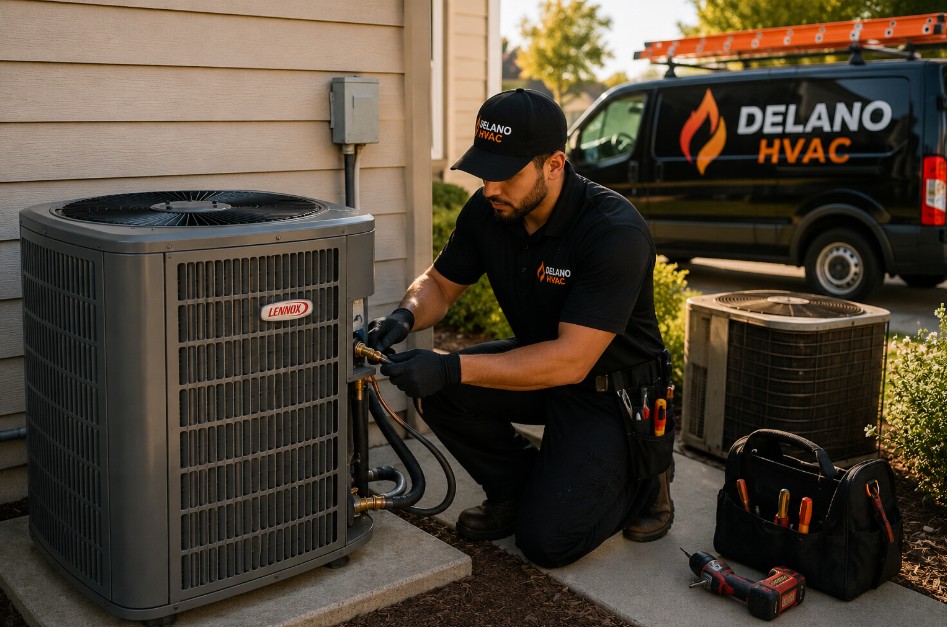
Should You Repair or Replace Your HVAC System?
There is no single answer that fits every situation. Both repair and replacement are valid — the right choice depends on your system's age, its current condition, how frequently it has needed service, and how it's performing relative to what it should be doing. Here's how to think through that decision clearly.
When Repair Makes Sense
- Your system is relatively new — under 8 to 10 years old — and the issue is isolated to a single component rather than a pattern of failures
- The repair addresses a clear, specific fault — a failed capacitor, a faulty sensor, a refrigerant leak at a traceable location — not a vague performance decline
- Repair cost is low relative to the system's remaining service life — a general benchmark is that repair should be less than 30 to 40 percent of replacement cost
- The system still runs efficiently between service events — your energy bills are stable and comfort levels are consistent across your Delano home
When Replacement Is the Better Option
- Your system is 12 to 15 or more years old — at this stage, efficiency has declined measurably and the risk of compounding failures increases every season
- The system has required significant repairs more than once in the past two seasons — a pattern that typically indicates broad component degradation, not an isolated issue
- Energy bills have risen noticeably without a corresponding change in usage — a sign the system is working harder than it should to maintain output as efficiency declines
- The system no longer maintains consistent heating or cooling throughout your home — uneven temperatures, rooms that won't reach set temperature, or humidity that feels wrong
A new, properly sized HVAC system typically delivers meaningfully lower operating costs, more consistent comfort, and fewer unplanned service calls than a repaired aging system — especially in Delano's demanding climate. When the cumulative cost of maintaining an older system approaches what a replacement would cost over the same period, replacement becomes the better financial decision. Starting a new system on a scheduled HVAC maintenance plan in Delano from installation protects that investment and ensures it performs at its designed efficiency from day one.
Explore HVAC System Replacement Options for Your Delano Home
Not every home in Delano is suited to the same HVAC system. The right replacement depends on your home's layout, existing infrastructure, energy priorities, and how you use heating and cooling across the year. Here's a clear overview of the three main system types we install for Delano homeowners.
Central Air Conditioning Systems
Central air conditioning remains the standard choice for whole-home cooling in Delano — and with good reason. A properly sized central AC system moves conditioned air through your existing ductwork, maintaining consistent temperatures across every room simultaneously. For Delano's long summers, it's the most practical solution for homeowners who need reliable, whole-home cooling performance through months of sustained heat.
Modern central AC systems offer significantly higher SEER ratings than equipment from even a decade ago — meaning the same cooling output at meaningfully lower energy consumption. For homes replacing older equipment, the efficiency difference is often significant enough to reduce energy costs noticeably within the first season.
Furnace Systems
Gas furnaces remain the most common residential heating system in Delano homes — and when the equipment is properly sized and installed, they deliver reliable, consistent heat output that handles Central Valley winters efficiently. A furnace replacement is an opportunity to move to a higher-efficiency model, improve heat distribution, and reduce the operating costs that come with an aging heating system that's lost efficiency over its service life.
Modern high-efficiency furnaces operate at AFUE ratings of 95 percent or above — meaning less fuel wasted and more heat delivered per dollar of gas consumed. For homeowners whose current furnace is over 15 years old, the efficiency improvement alone typically delivers a meaningful return on the replacement investment within a few heating seasons.
Heat Pump Systems
Heat pumps handle both heating and cooling from a single system — making them an increasingly popular choice for Delano homeowners looking to consolidate their heating and cooling equipment into one efficient unit. Rather than generating heat, a heat pump moves heat energy — pulling it from outside air to warm your home in winter and transferring it out in summer. In Delano's relatively mild winters, this approach is highly energy-efficient.
Modern heat pump technology has improved significantly, and systems now perform reliably well below the temperatures Delano typically reaches. For homes without existing gas service or for homeowners planning an energy-efficient upgrade, a heat pump system offers a compelling combination of year-round comfort and lower operating costs compared to separate heating and cooling systems.
Choosing the right system also depends on your home's size, insulation quality, existing ductwork condition, and long-term energy goals. Every replacement we recommend begins with a proper load calculation and a clear conversation about your priorities — so the system you choose is the one that actually fits your home. Once installed, pairing your new system with a scheduled HVAC maintenance plan in Delano ensures it continues to perform at its rated efficiency from day one.
Signs It May Be Time to Replace Your HVAC System
HVAC systems don't usually stop working all at once — they give signals over time that performance is declining. Recognizing these patterns helps Delano homeowners make the replacement decision from a position of clarity rather than waiting for a complete failure to force it. Staying ahead of these signs is also one of the reasons regular HVAC maintenance matters — many of them show up clearly during a routine inspection before they affect comfort or efficiency.
System Is Over 10–15 Years Old
Age alone isn't a reason to replace — but it's the most important context for evaluating everything else. A 15-year-old system that's performing well and running efficiently may have a few more seasons left. That same system with recurring repair needs, rising energy bills, or inconsistent output is a different calculation. Most manufacturers design residential systems for a 15 to 20 year service life under normal conditions; Delano's extended cooling season often brings that range closer to the lower end.
Frequent Repairs Are Needed
One repair in a season is usually just a repair. Two or three in the same season — or a pattern of different components failing across consecutive years — indicates broader system degradation rather than isolated faults. When you're scheduling AC repair in Delano or furnace service multiple times in a short period, the total cost of those repairs begins to approach what replacement would cost, without the benefit of starting fresh with modern, efficient equipment.
Rising Energy Bills Without Increased Usage
An HVAC system that's losing efficiency doesn't announce it directly — it shows up on your utility bill. When energy costs climb during a season without a corresponding change in how much you're using the system, the equipment is working harder than it should to produce the same output. Dirty coils, worn compressor components, and refrigerant issues all contribute to this pattern — and in a Delano home running AC for five months of the year, the cumulative cost adds up faster than most homeowners expect.
Uneven Temperatures Throughout the Home
When certain rooms stay noticeably warmer or cooler than others — regardless of thermostat settings — it often points to a system that can no longer distribute conditioned air evenly. This can result from duct deterioration, a system that was never sized correctly for the home's current configuration, or an aging blower and compressor operating below capacity. Rooms farthest from the air handler are typically the first to reflect these imbalances.
System Runs Constantly or Struggles to Maintain Temperature
A properly functioning HVAC system cycles on, reaches the set temperature, and shuts off — then repeats that cycle at reasonable intervals. When a system runs continuously without reaching the thermostat target, or cycles so frequently that it never stabilizes, it's usually indicating reduced capacity from component wear. In Delano's summer conditions, a system that struggles to maintain 74°F indoors when the thermostat is set to 74°F isn't a settings issue — it's a performance issue that typically indicates the system has reached or exceeded its practical service life.
What Affects the Cost of HVAC System Replacement in Delano, CA?
HVAC replacement costs vary considerably from home to home — because no two homes have identical systems, layouts, or requirements. Understanding the factors that influence cost helps you evaluate quotes clearly and make a replacement decision based on the full picture rather than a single number.
The capacity of the system you need — measured in tons of cooling or BTUs of heating — is determined by your home's square footage, ceiling height, insulation quality, and sun exposure. A larger home with poor insulation requires a higher-capacity system than a well-sealed home of the same size. Getting sizing right from the start matters: an oversized or undersized system doesn't perform as well as one matched precisely to the load calculation for your specific Delano home.
Central air conditioning systems, gas furnaces, and heat pumps each sit in different cost ranges — reflecting differences in equipment complexity, refrigerant type, and installation requirements. A split system AC and furnace combination has different pricing considerations than a complete heat pump system. For homes considering a heat pump upgrade, our heat pump services in Delano include a full assessment of whether that system type is the right fit for your home's configuration before any recommendation is made.
Higher-efficiency systems — those with higher SEER ratings for cooling or higher AFUE ratings for heating — typically carry a higher upfront equipment cost. The trade-off is lower monthly operating costs over the life of the system. For a Delano home that runs air conditioning heavily from May through September, the payback period on a higher-efficiency system is often shorter than homeowners expect. The right efficiency tier depends on your utility rates, how long you plan to stay in the home, and your annual operating hours.
Labor cost is influenced by how straightforward or complex the installation is. A direct equipment swap in a home with accessible, intact ductwork is simpler than a replacement that requires duct repairs, a new line set run, or working in a tight attic or crawl space. Homes that are replacing aging or incorrectly configured ductwork alongside the new system will see higher total installation costs — but the result is a properly installed system that performs as designed rather than inheriting the inefficiencies of the old configuration.
A replacement is a practical opportunity to add features that improve long-term performance: a smart thermostat for more precise temperature management and remote control, zoning systems for homes where different areas have different heating and cooling needs, or air quality improvements such as whole-home filtration. These additions affect the total project cost but often deliver measurable comfort and efficiency returns. Pairing a new system with a scheduled HVAC maintenance plan in Delano from installation protects the investment and ensures peak performance from day one.
Understanding these factors helps homeowners make informed decisions when planning a system upgrade — and ensures that estimates you receive reflect the actual requirements of your home rather than a generic price point.
Our HVAC Replacement Process for Delano Homes
At Delano HVAC, every system replacement is planned carefully from the first visit to the final test — ensuring that the equipment we install is correctly specified for your home, properly installed by licensed technicians, and verified to be performing before we leave.
In-Home Evaluation
A licensed technician visits your Delano home to assess the current system condition, measure the space, review insulation and ductwork, and identify everything that affects your replacement requirements — before any equipment is recommended or priced.
System Recommendation
Based on your home's load calculation, we recommend the system type, capacity, and efficiency tier that best matches your comfort needs, usage patterns, and long-term cost goals — with a clear explanation of each option and an upfront price before you decide anything.
Professional Installation
The old system is safely removed and the new system is installed to manufacturer specifications — correct refrigerant charge, properly sealed connections, code-compliant electrical work, and clean duct tie-ins. No shortcuts that affect long-term performance or efficiency.
Final Testing & Optimization
We run the system through a full performance verification — airflow measurement, temperature differential check, thermostat calibration, and a room-by-room comfort check. You receive a walkthrough of the system before the job is closed, so you understand exactly what was installed and how it works.
Whether you're replacing a central air conditioner, a gas furnace, or upgrading to a heat pump, this process is how we approach every installation. For cooling replacements, our AC installation service in Delano covers the full specification and installation. For heating, our furnace installation service handles everything from equipment selection to final test — with the same upfront pricing and licensed technicians on every job.
HVAC System Replacement in Delano, CA — Frequently Asked Questions
Homeowners often have questions when considering a full system upgrade. At Delano HVAC, we focus on providing clear and practical answers to help you make informed decisions — without pressure and without confusion.
Answered
HVAC system replacement costs in Delano vary based on the type of system being installed, the capacity required for your home, the efficiency rating of the equipment, and the complexity of the installation. A straightforward equipment swap in a home with accessible, intact ductwork is priced differently from a replacement that includes ductwork repairs or new line sets.
We provide a complete, itemized estimate after an in-home evaluation — so the price you receive reflects your specific home and requirements, not a generic range. There are no hidden fees or changes to the quoted price after you approve the work.
Most residential HVAC system replacements in Delano are completed within a single day. A standard split system swap — removing the old equipment, installing the new unit, connecting refrigerant lines, and completing electrical work — typically takes between four and eight hours depending on the system type and access to the equipment location.
Installations that involve ductwork modifications, a new thermostat wiring run, or unusual equipment placement may take slightly longer. We confirm the expected timeline when we provide your estimate so there are no surprises on installation day.
Most residential HVAC systems are designed for a service life of 15 to 20 years under normal operating conditions. In Delano's Central Valley climate — where air conditioners run heavily for five or more months each year — systems at the lower end of that range are more common without proper care.
Systems that receive regular professional maintenance consistently outperform those that don't — staying closer to the upper end of the expected lifespan while maintaining better efficiency throughout. Manufacturer warranties on new equipment also typically require documented maintenance to remain valid.
Repair makes more sense when the system is under 10 years old, the issue is isolated to a single component, and the repair cost is low relative to the system's remaining value. Replacement becomes the better financial decision when the system is 12 to 15 or more years old, has required multiple repairs in recent seasons, or is consuming significantly more energy than a newer system would.
A useful benchmark: if the repair cost exceeds 40 to 50 percent of what replacement would cost on an aging system, replacement typically delivers better long-term value. If you're unsure whether repair is still the right call, our AC repair service in Delano includes an honest assessment of system condition and remaining service life — with no pressure toward replacement if repair is genuinely the right answer.
Yes — in most cases, meaningfully so. Modern HVAC systems operate at significantly higher efficiency ratings than equipment manufactured 10 or 15 years ago. A system with a higher SEER rating for cooling or a higher AFUE rating for heating uses less energy to produce the same output, which directly reduces monthly operating costs.
For a Delano home running air conditioning heavily from May through September, the energy savings from a modern high-efficiency system compared to aging, degraded equipment can be substantial — often enough to offset a meaningful portion of the replacement cost over the system's lifespan.
Yes — and starting maintenance from installation is the most effective approach. A new system that receives regular professional tune-ups maintains its efficiency ratings, extends its service life, and avoids the kind of gradual component degradation that leads to unplanned repairs. Most manufacturers also require documented maintenance visits for warranty coverage to remain valid.
Our HVAC maintenance service in Delano covers new systems with a seasonal inspection schedule — spring before cooling season and fall before heating season — so your replacement investment performs at its designed efficiency from day one and continues to do so for years.
Upgrade Your HVAC System with Confidence in Delano, CA
At Delano HVAC, we help homeowners choose and install systems that deliver long-term performance, efficiency, and comfort. Whether you're planning a new AC installation in Delano or replacing an aging unit, our licensed technicians ensure a smooth, professional experience — with upfront pricing and no surprises.
